How Blockchain Solves Real Estate Fragmentation
January 29, 2026

The global real estate market, valued at hundreds of trillions, grapples with a fragmentation crisis, characterized by disconnected systems, siloed data, and a severe lack of interoperability across its complex value chain. This inherent inefficiency leads to prolonged transaction times, inflated costs, and significantly reduced liquidity, hindering innovation and accessibility.
Blockchain technology emerges as a transformative solution, offering a path to modernize property transactions and dismantle these systemic inefficiencies. Through the innovative application of tokenization and distributed ledger technology, blockchain promises to unify disparate systems, streamline processes, and unlock unprecedented liquidity in an otherwise rigid market.
Understanding Real Estate Fragmentation: Root Causes
Real estate fragmentation refers to the pervasive disunity within the property sector, where various stakeholders operate in isolated environments, preventing seamless information flow and efficient transaction execution. This leads to a complex and often opaque market.
- Legacy Infrastructure: The industry heavily relies on outdated, paper-based processes, manual verification, and antiquated registry systems, creating bottlenecks and increasing the potential for errors.
- Geographic and Jurisdictional Barriers: Property transactions are complicated by diverse regulations, varying standards, and inconsistent data formats across different regions and countries.
- Multiple Intermediaries: A typical property transaction involves numerous intermediaries: brokers, lawyers, banks, and title companies, each adding layers of complexity, cost, and information asymmetry. 89% of sellers and 88% of homebuyers utilized a real estate agent in 2026, indicating the prevalence of intermediaries.
- Lack of Standardization: The absence of uniform property data, valuation methods, and transaction protocols exacerbates fragmentation, making cross-market analysis and investment challenging.
How Blockchain Creates a Unified Real Estate Ecosystem
Blockchain technology provides a robust framework to address real estate fragmentation by establishing a single, verifiable source of truth and automating complex processes. This foundational shift enables a more integrated and efficient ecosystem.
- Distributed Ledger Technology: Blockchain creates a shared, immutable ledger accessible to all authorized participants, ensuring a single source of truth for property data and transaction history. This eliminates discrepancies and builds trust among stakeholders.
- Smart Contracts: These self-executing agreements automate critical steps in property transactions, from escrow to ownership transfer. Smart contracts minimize manual intervention, reduce errors, and ensure compliance with predefined conditions. They are crucial for automated compliance, payments, and transfers.
- Tokenization: Real estate tokenization converts physical assets into digital tokens on a blockchain, representing fractional ownership. This innovation enables divisible ownership, significantly enhancing liquidity and lowering barriers to entry for investors.
- Interoperability Protocols: Blockchain platforms are developing protocols that connect previously siloed systems, allowing diverse stakeholders from regulators to developers to interact on a common, secure infrastructure.
Speed Gains: From Months to Minutes
Traditional real estate transactions are notoriously slow, often taking months to complete due to manual processes and numerous intermediary checks. Blockchain significantly accelerates this timeline.
A typical property transaction can span 123 days from instruction to completion, involving multiple approval stages and verifications. Blockchain technology compresses this duration dramatically by enabling near-instant verification, automated compliance checks, and real-time settlement.
For instance, smart contracts streamline real estate deals by cutting transaction times by up to 30% through automation and reduced paperwork. This efficiency is achieved by removing redundant verification steps and allowing direct, peer-to-peer transfers with cryptographic security, bypassing traditional bottlenecks.
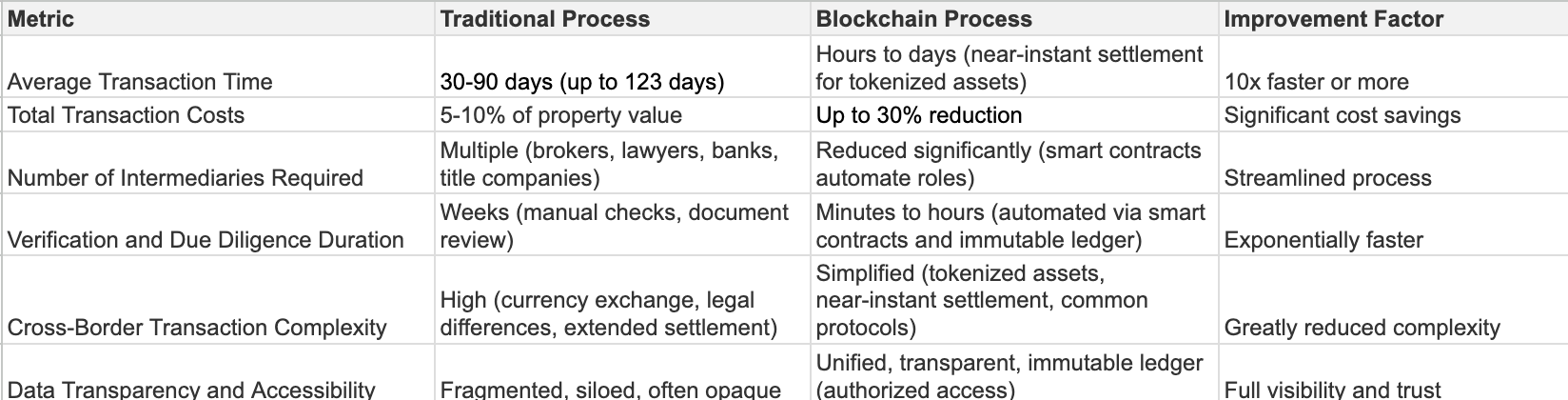
Traditional vs Blockchain Real Estate Transactions
This comparison table illustrates the fundamental differences between conventional real estate processes and blockchain-enabled transactions across key performance metrics. It demonstrates why blockchain represents a paradigm shift in addressing fragmentation and speed challenges.
Cost Reduction Through Disintermediation
Traditional real estate transactions are burdened by substantial costs, often ranging from 5-10% of the total property value, primarily due to fees incurred from various intermediaries like agents, legal services, title insurance, and administrative overhead. Blockchain technology directly confronts these costs through disintermediation and enhanced efficiency.
Blockchain efficiency eliminates redundant verification steps and reduces reliance on intermediaries. For example, blockchain could reduce real estate transaction costs by up to 30% by eliminating inefficiencies and streamlining settlement and verification processes. Layer 2 networks have achieved significant savings, with transaction costs dropping from approximately $24 in 2021 to less than $0.01 by 2026.
This transparency, coupled with clear audit trails, reduces fraud risk and can even lower insurance premiums. The overall impact is a significant reduction in total transaction costs, making property ownership and investment more accessible and affordable.
Integra's Approach to Solving Fragmentation
Integra is at the forefront of tackling real estate fragmentation by providing a comprehensive blockchain-powered platform designed to connect and optimize the entire property value chain. Our solutions are built to foster a unified and efficient ecosystem.
- Platform Architecture: Integra's robust architecture seamlessly integrates regulators, institutions, developers, and other stakeholders, creating a cohesive environment for property transactions.
- Tokenization Infrastructure: We provide the essential infrastructure to enable the compliant tokenization of real estate assets, transforming illiquid properties into liquid, tradable digital assets.
- Interoperable Workflows: Integra creates standardized protocols that facilitate cross-border and cross-platform transactions, breaking down geographical and system-specific barriers.
- Real-World Implementation: Integra has successfully deployed solutions that significantly reduce fragmentation, demonstrating tangible improvements in transaction speed and cost efficiency across various use cases.
Regulatory Compliance and Institutional Adoption
The path to widespread blockchain adoption in real estate hinges on robust regulatory frameworks and growing institutional confidence. Integra prioritizes compliance by design, ensuring its platform meets and exceeds industry standards.
Blockchain's inherent security features and audit capabilities, such as immutable ledgers and transparent transaction histories, meet the stringent requirements of enterprise-grade solutions. Regulators globally are increasingly adopting the principle of “same activity, same risk, same regulatory outcome,” ensuring tokenized securities adhere to existing rules for investor protection and disclosure.
Jurisdictions like the EU (MiCA), Germany (eWpG), and Dubai (VARA) are establishing clear regulatory frameworks that support tokenized real estate, accelerating institutional adoption. The market for tokenized real estate assets is projected to reach $3.5 billion by 2026, with some estimates suggesting a potential for $4 trillion by 2035, driven by this regulatory clarity and institutional interest.
Key Takeaways
- Real estate fragmentation leads to high costs, slow transactions, and reduced liquidity.
- Blockchain technology, through distributed ledgers and smart contracts, unifies disparate systems.
- Tokenization enables fractional ownership, boosts liquidity, and lowers investment barriers.
- Blockchain can reduce transaction times by over 10x and costs by up to 30%.
- Integra provides the platform to connect stakeholders and enable compliant, liquid real estate assets.
- Regulatory clarity and institutional adoption are accelerating the shift to blockchain in real estate.
Conclusion: The Path Forward for Real Estate
The fragmentation crisis in real estate has long stifled efficiency and accessibility. Blockchain technology offers a definitive solution, providing unified data, automated processes, and significantly increased liquidity that can transform the industry.
Real estate tokenization is transitioning from pilot experiments to production-scale financial infrastructure, with a projected market reaching USD 23.99 billion by 2035. Stakeholders, including real estate professionals, developers, institutions, and regulators, must embrace this technological shift to modernize their operations and unlock new opportunities.
Integra stands as the foundational infrastructure layer enabling this crucial transformation. By leveraging our platform, the real estate industry can move beyond fragmentation towards a future of unparalleled efficiency, transparency, and liquidity.
Frequently Asked Questions
How does blockchain reduce real estate transaction time?
Blockchain significantly reduces real estate transaction time by automating processes through smart contracts, which execute agreements instantly upon predefined conditions. The distributed ledger eliminates manual record-checking and reconciliation, while tokenization enables near-instant settlement of asset transfers. This can accelerate transaction speeds by over 10x compared to traditional methods.
What is real estate fragmentation and why does it matter?
Real estate fragmentation is the state of disconnected systems, siloed data, and a lack of interoperability across the real estate value chain. It matters because it leads to prolonged transaction times, increased costs from numerous intermediaries, reduced market liquidity, and hinders investment accessibility.
Is blockchain real estate legally compliant?
Yes, blockchain real estate can be legally compliant. Platforms like Integra are designed with "compliance by design," integrating regulatory requirements directly into their architecture. Jurisdictions globally, including the EU (MiCA), Germany (eWpG), and Dubai (VARA), are establishing specific frameworks for tokenized real estate, ensuring legal validity and investor protection.
How much does blockchain reduce property transaction costs?
Blockchain can reduce property transaction costs by up to 30%. This is achieved by eliminating or reducing reliance on multiple intermediaries (e.g., lawyers, title companies, brokers), automating verification processes through smart contracts, and significantly lowering payment processing fees, which can drop to less than $0.01 on Layer 2 networks.
What is real estate tokenization and how does it solve fragmentation?
Real estate tokenization is the process of converting physical property assets into digital tokens on a blockchain. It solves fragmentation by enabling fractional ownership, making illiquid assets highly divisible and easily tradable 24/7 on global markets. This enhances liquidity, lowers investment barriers, and integrates disparate market participants onto a common digital infrastructure.
Which institutions are using blockchain for real estate in 2026?
In 2026, institutional adoption of blockchain in real estate is widespread, with major asset managers and financial institutions actively exploring or implementing tokenization solutions. Regulatory bodies globally are supporting blockchain infrastructure, and platforms like Integra are enabling enterprise-grade solutions for commercial properties and cross-border investments.
Recent Blogs

Welcome to the Integra Testnet: A First-Time User's Guide
.png)
Data is the Missing Infrastructure of Tokenized Real Estate
How Blockchain Solves Real Estate Fragmentation

Unlock Liquidity from Illiquid Real Estate Assets
Inside Integra