Data is the Missing Infrastructure of Tokenized Real Estate
March 7, 2026
.png)
Discussions on real estate tokenization often start with ownership, focusing on fractionalization, liquidity, and global access. However, information, not ownership, is the main bottleneck.
Behind every real estate transaction sits a complex stack of data: title records, zoning information, valuation reports, financing structures, insurance policies, compliance filings, and operating performance. In traditional markets, this information is scattered across many parties, including brokers, legal teams, asset managers, and regulatory registries. Even within a single transaction, different participants maintain their own version of the asset record.
Tokenization does not resolve this fragmentation. Data often moves onto a blockchain without proper structure, producing tokens that represent ownership but lack full asset context.
As a result, investors are left without critical information about the property's financial performance, legal standing, or operational history, making it difficult to accurately assess risk or make informed decisions. This lack of transparency can increase uncertainty, hinder due diligence, and ultimately limit investor confidence and participation in tokenized real estate markets.
The next phase of tokenized real estate should focus on organizing, verifying, and making property data accessible to markets.
The Information Gap in Property Markets
Real estate markets operate very differently from public financial markets. In public markets, information flows continuously. Financial statements are standardized, trading history is accessible, and price signals update constantly.
Real estate relies on a fragmented, subjective information structure. Financial performance is often visible only to a small group of stakeholders. Valuation methodologies can differ widely between transactions. Documentation that explains the structure of a deal often exists only inside private diligence rooms.
This fragmentation creates friction for institutional investors who assess risk, cash flow, and legal structure. When these elements remain in unstructured documents, tokenization alone offers limited efficiency gains.
The industry has focused on digitizing ownership while largely leaving asset information unchanged.
Why Data Structure Matters
This is where the role of structured real estate data becomes critical.
Building, Inc helps developers and asset managers organize property information for reuse across multiple workflows. Rather than creating new documentation for each transaction, the property itself becomes a structured dataset that can power diligence, compliance checks, financing discussions, and investor reporting in perpetuity.
For example, a property manager using Building’s platform can store financial statements, lease terms, compliance records, and maintenance data in a standardized, credentialed format linked to the asset. When an investor requests due diligence or a lender requires updated compliance information, the manager can instantly grant selective access to the relevant data. This eliminates repetitive document gathering, speeds up transaction timelines, and ensures all parties are working with the same, verified source of truth.
Structured property information becomes portable across systems. Lenders, investors, and marketplaces can access the same canonical dataset for financing, diligence, or listing. This shift makes asset data easier to verify, compare, and integrate into financial markets.
Crucially, this process must be continuous. Property data is not created once and stored indefinitely; it evolves throughout the asset lifecycle. Infrastructure that structures and verifies this information must therefore operate as a persistent data pipeline, ensuring that asset information is refreshed, validated, and distributed to markets as conditions change.
Trust in Tokenized Assets
Tokenization introduces a new challenge: trust must extend beyond the blockchain.
A blockchain can record transactions with high reliability, but it cannot independently verify real world facts about a property. The quality of a tokenized asset, therefore, depends heavily on how well the off-chain information surrounding that asset is organized and verified.
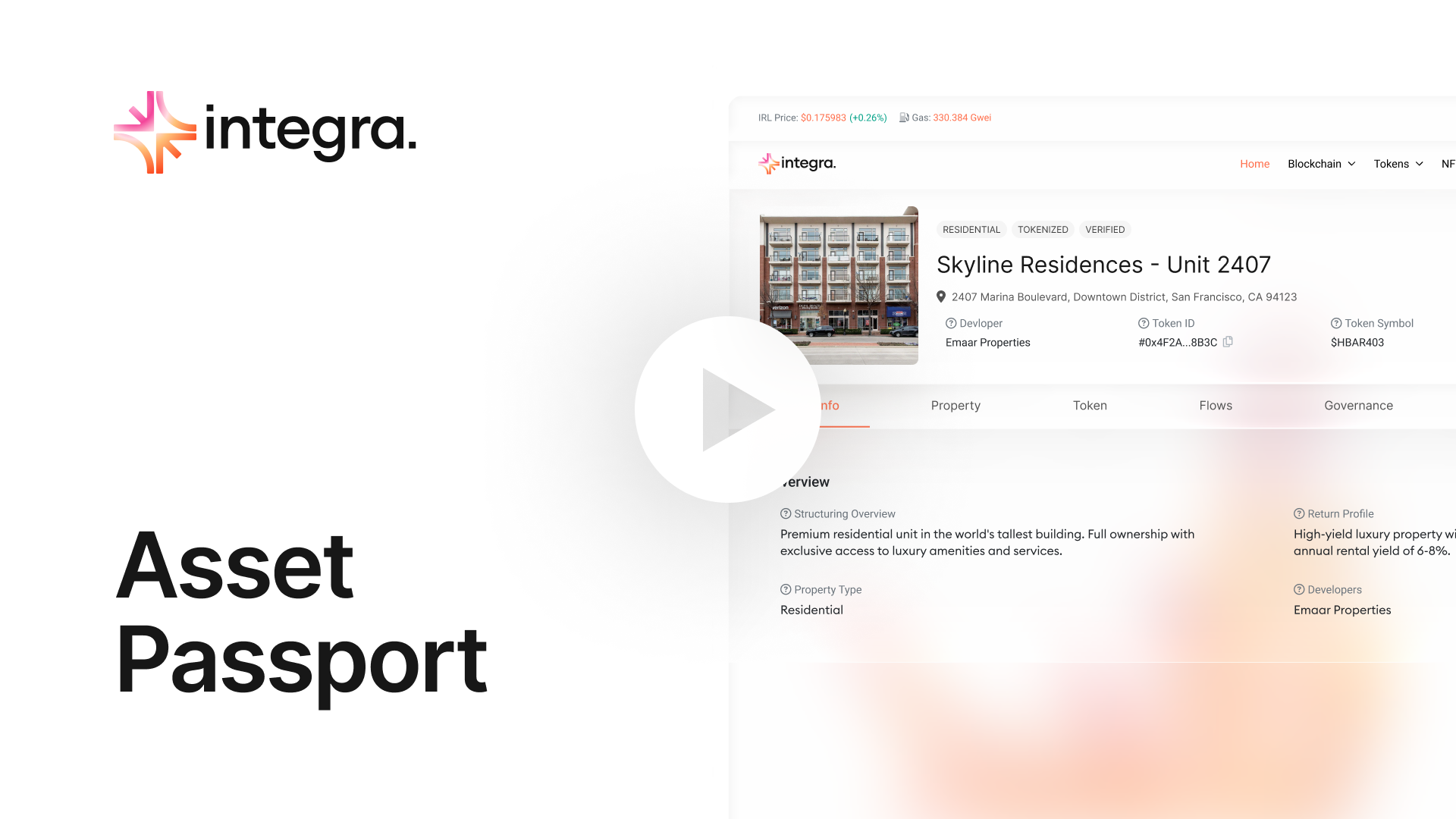
Integra approaches this challenge through a registry layer known as Asset Passport, which creates a persistent profile for each property that includes both on-chain activity and real world information.
To ensure trust in the off-chain data, Asset Passport applies a verification process that requires third-party validators to review and authenticate key documents and facts about the property before they are added to the asset profile. This can include title records, compliance certificates, or financial statements, each time-stamped and digitally signed within the registry. These verified records give investors a transparent view of which data points have undergone independent validation, strengthening the overall trustworthiness of the system.
The passport extends transparency beyond transaction data by aggregating asset history, ownership structure, compliance documents, and operational activity into one interface.
This transforms the asset into a continuously updated record rather than a static token. Investors can review the property lifecycle, regulators verify compliance, and marketplaces rely on consistent data even if tokens move across chains.
The token is just one part of a broader asset identity system.
Price Discovery Requires Visibility
Liquidity in financial markets depends on information symmetry. Participants need enough visibility into an asset to form independent opinions about its value.
Real estate has historically struggled with this. Comparable transactions may be private, operational performance data is rarely standardized, and valuation reports often rely on proprietary assumptions.
Real estate markets operate very differently from financial markets in terms of price discovery.

In equities, price discovery happens continuously as new information enters the market. In real estate, prices often update only when a property trades, which may happen years apart. Valuations in between transactions are typically based on comparable sales that may already be months old.
This is one reason liquidity in property markets has historically remained limited. Investors cannot easily evaluate an asset if the underlying information is incomplete or outdated.
Without closing the information gap, tokenized real estate secondary markets face weak price discovery. Buyers hesitate due to incomplete asset records, and sellers struggle to demonstrate value beyond initial offerings.
Structured property data changes this dynamic. Consistent recording of performance, valuation inputs, and transaction history makes assets easier to compare and builds investor confidence in transparent pricing.
When asset data is structured and continuously maintained, markets no longer need to rebuild diligence packages from scratch each time an asset is evaluated. Instead, key inputs can be refreshed incrementally, making valuation updates faster, more frequent, and easier to integrate into pricing models.
In other words, transparency is not just a governance benefit. It is a market function.
Compliance as Infrastructure
Regulatory compliance is another area where data architecture becomes critical.
In a survey conducted by EY-Parthenon, 49% of institutional investors identified regulatory uncertainty as the primary obstacle to tokenized assets. Structured property data can help address these concerns by embedding compliance requirements directly into the asset record.
For example, standardized data formats can allow real-time verification of regulatory obligations, automate reporting, and make it easier for auditors and regulators to access necessary information. By providing clear, consistent, and easily accessible compliance evidence, structured data reduces ambiguity and helps market participants navigate evolving regulations with greater confidence.
Real estate transactions involve a wide range of compliance checks, from securities regulation to property title verification and investor accreditation. Traditionally, these checks are handled through document exchange between intermediaries.
Tokenized markets enable embedding these verifications directly into the asset record.
Instead of relying solely on issuer disclosures, investors can identify which parties verified the asset's legal, financial, or operational aspects. This approach transforms compliance from a document process into programmable infrastructure.
These records also influence how assets are treated financially. Valuation inputs, risk disclosures, and operational performance data ultimately affect accounting treatment, reserve requirements, and regulatory reporting.
When these inputs are structured and verifiable, institutions can assess risk more confidently and apply consistent financial classifications to tokenized assets.
From Documents to Asset Identity
A deeper shift is emerging from these developments.
Historically, real estate assets have been defined by documents such as deeds, contracts, reports, and filings. Each document represents a snapshot of the asset at a specific moment.
Digital infrastructure enables this model to evolve into a more dynamic form.
When property information, compliance attestations, and transaction activity are aggregated into a single record, the asset begins to develop a persistent digital identity. This identity captures the property's full lifecycle rather than a collection of disconnected documents.
This creates transparency for investors and regulators, a rarity in traditional real estate markets.
A New Layer in Real Estate Markets
Tokenization is often seen as a technological shift, but the bigger change is in structuring and sharing real estate information.
Building Inc. structures property data for efficient movement across compliance, financing, and ownership workflows. Integra builds blockchain infrastructure supporting transparent histories, verified attestations, and programmable financial interactions.
Understanding these systems requires viewing tokenized real estate as a layered infrastructure stack.
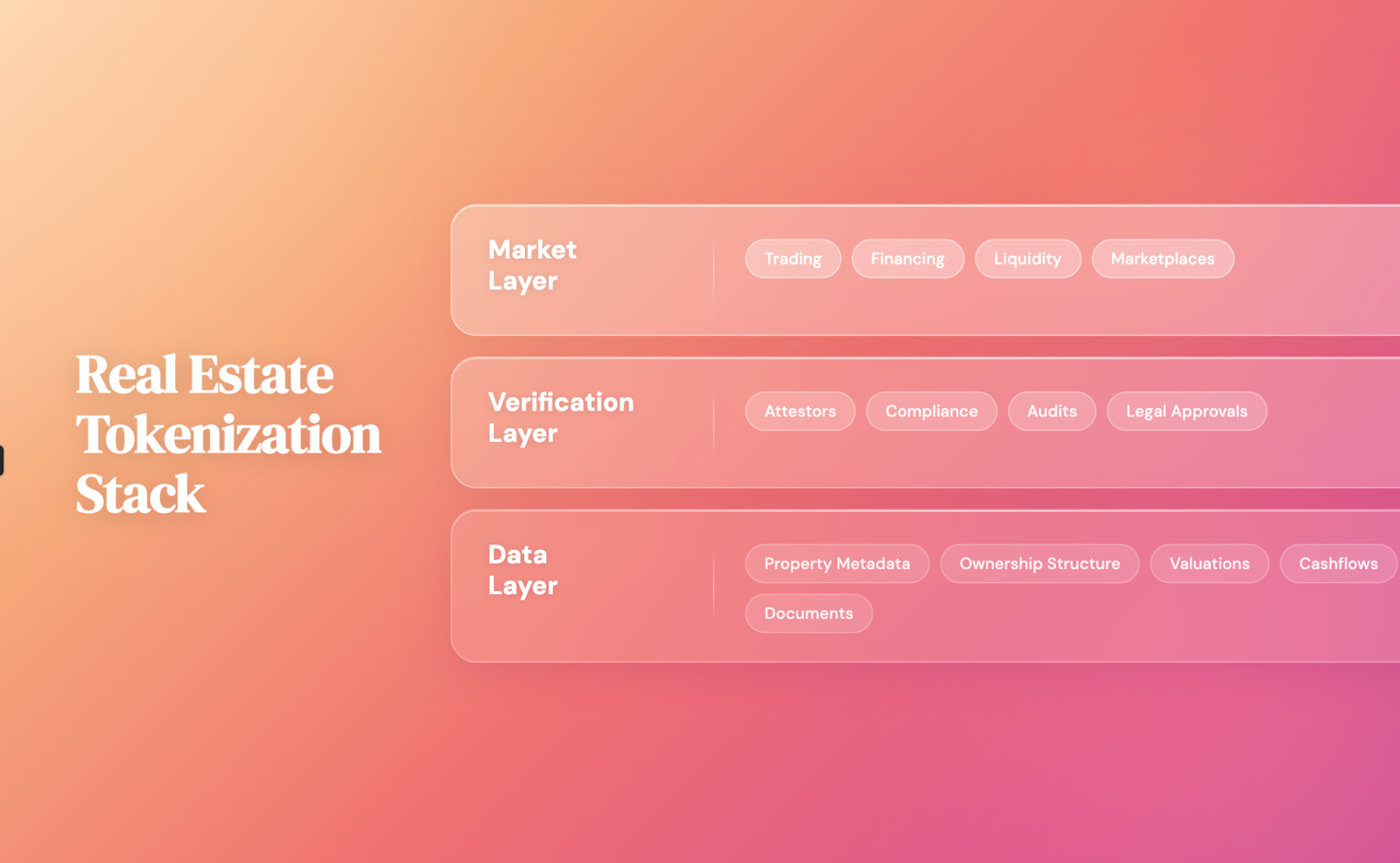
Together, these systems represent an emerging layer of market infrastructure: one in which real estate assets are not only tokenized but also accompanied by verifiable, structured data.
This combination ultimately enables trust, price discovery, and institutional participation.
To take advantage of these developments, institutional investors should prioritize integrating structured property data and verified asset profiles into their investment and risk assessment processes. By actively engaging with platforms that offer transparent, standardized information, investors can enhance their due diligence, identify opportunities more confidently, and position themselves at the forefront of the evolving tokenized real estate market.
Recent Blogs

Welcome to the Integra Testnet: A First-Time User's Guide
Data is the Missing Infrastructure of Tokenized Real Estate

How Blockchain Solves Real Estate Fragmentation

Unlock Liquidity from Illiquid Real Estate Assets
Inside Integra